Clinical platform · Hair restoration
One platformfor the wholetransplant workflow.
Graft calculation, medical reports, twelve-month growth simulation and patient messaging — writing to a single clinical record.
A clinical procedure run on consumer tools.
The deck puts manual counting error at 15–20%. That figure ships hatched until a source is attached to it.
The scale every surgeon plans against.
Frontal recession with vertex involvement
The frontal hairline has moved back further, and a distinct thinned area has developed at the vertex. A moderately dense band of hair still separates the two.
- Frontal loss
- 16%
- Vertex loss
- 30%
- Mid-scalp bridge
- 85%
Stage descriptions paraphrased from the published Hamilton–Norwood classification (Hamilton 1951, revised Norwood 1975). The surgical range reflects the general clinical convention that stages 3–5 balance achievable coverage against available donor supply — it is not a recommendation, and candidacy is a decision for a surgeon.
The scalp is six regions, not one surface.
Hover or select a region to see what makes it different.
One illustrative case. Region areas and counts vary enormously with Norwood stage, skull size and donor supply — a fixed table presented as typical would be a clinical claim, not an example. Region names follow the standard surgical vocabulary.
Five modules that only make sense together.
Every module writes to the same patient record. The graft calculation the surgeon approves is the one the simulation renders, the chat references and the invoice is priced against.
One record, enquiry to twelfth month
Every photo, measurement, consent, price and message attached to one patient timeline. Structured from the first enquiry, so a case is still auditable years later.
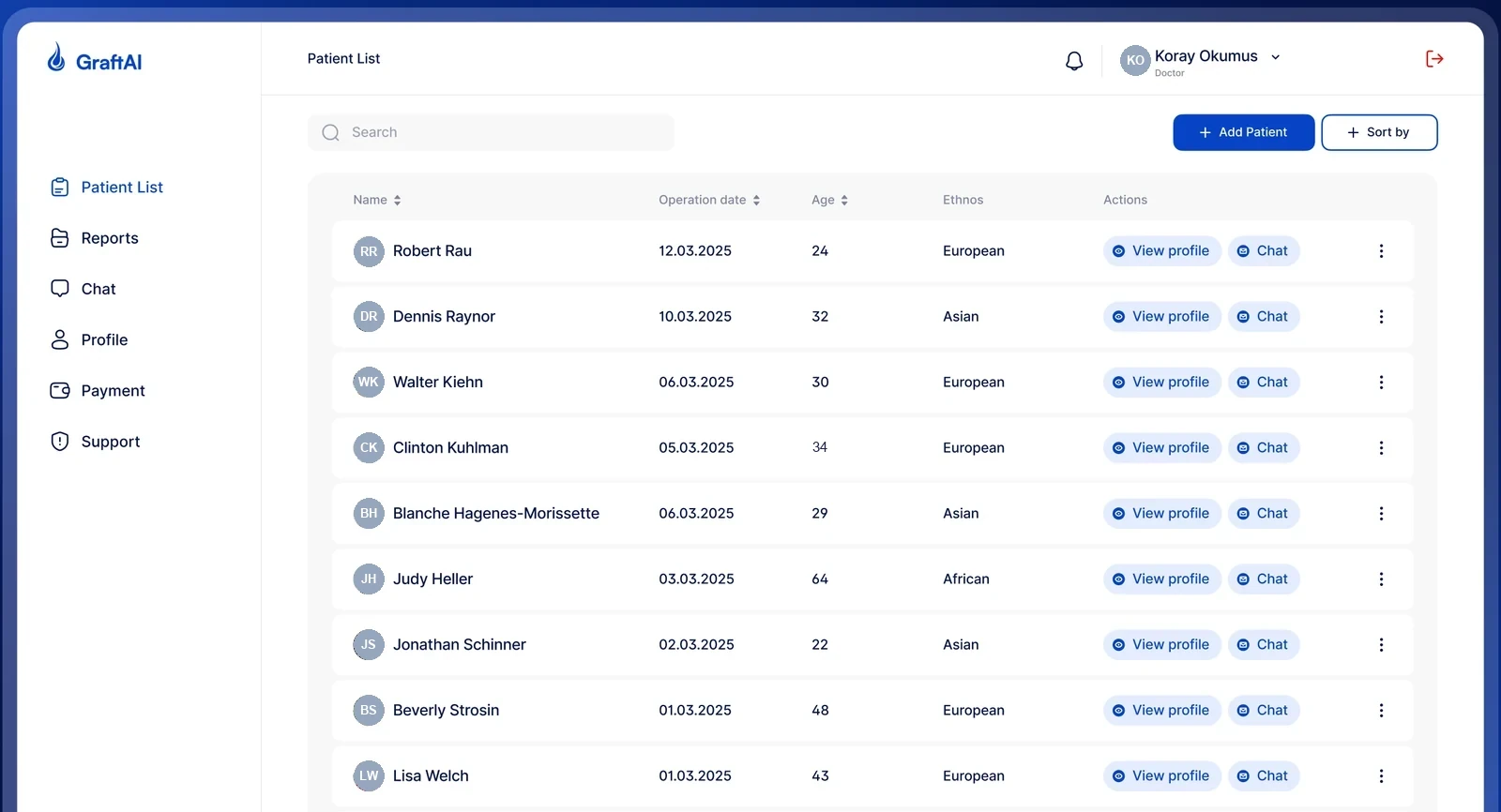
- Operation date, age and hair characteristics on one row
- Invite the patient into their own record
- Role-based access across the clinic team
The established platforms book and bill. None of them measure.
| Capability | Practice managementSchedules, bills, stores photos | Trichoscopy / imagingMeasures, then stops | Consumer simulation appsNever reaches the surgeon | GraftAIOne record, all five |
|---|---|---|---|---|
| Graft measurement from photos | Not covered | Full | Not covered | Full |
| Structured clinical record | Partial | Not covered | Not covered | Full |
| Outcome simulation | Not covered | Not covered | Partial | Full |
| Branded medical reports | Not covered | Partial | Not covered | Full |
| Patient messaging & follow-up | Partial | Not covered | Not covered | Full |
Category comparison, not a product benchmark. Drawn from published feature lists for the category rather than from testing, and no named vendor is being characterised.
The combination is the product. Every capability exists somewhere; what does not is one record where the measurement the surgeon approves is the one the simulation renders, the report prints and the invoice is priced against.
This could not have been built three years ago.
The clinic platform and the patient tool are one system.
The defensible asset is the consented outcome dataset. A competitor can rebuild a CRM in a quarter; they cannot rebuild years of paired pre-operative maps and verified results.
Growth simulation
The patient seestwelve months outbefore they commit.
The same measurement drives a growth simulation the patient can review at home, so expectation and plan are set against one shared reference.
Drag to move the boundary across the scalp. Behind it, the recipient zones are restored to the planned density — the same graft count the report quotes.
Where the grafts come from.
Units are removed one at a time and scattered across the donor band, so no single area is thinned visibly.
- 1Punch incision around each follicle
- 2Extraction of the follicular unit
- 3Trimming and sorting
- 4Implantation of the grafts
For planning: the count is bounded by how widely extraction can be spread before the band looks thin — a density judgement across the whole area, not a simple total.
Posterior view · occipital donor band
A strip of tissue is taken from the donor band and dissected into individual units under magnification.
- 1Strip harvesting from the donor band
- 2Slivering into follicular units
- 3Trimming and sorting
- 4Implantation of the grafts
For planning: yield per session is higher, so a large recipient area can be covered in fewer sittings — at the cost of a line the patient has to be able to cover.
Both methods are current surgical practice and the trade-off between them is genuine. Nothing here recommends one over the other — that is a decision for a surgeon and a patient, based on donor characteristics, how the patient wears their hair, and how many sessions are anticipated. Note that the two procedures differ only in how tissue leaves the donor area; from trimming onward they are the same operation.
The transplanted hair falls out first.
First regrowth
≈12% of final resultFine, soft hairs begin to emerge, sparse and uneven. It looks like baby hair because it is: new shafts growing from follicles that have restarted their cycle.
Curve drawn from published clinical consensus on post-operative growth. Shedding is reported anywhere from 10% to 90% of placed shafts and neither extreme predicts the outcome; final results are generally described as reached between 12 and 18 months. These are ranges, not guarantees, and individual recovery varies.
A platform holding patient photographs has to answer for them.
Stated plainly: no ISO 27001, no HIPAA attestation, no CE mark today. The above describes how the system is designed — not audits it has passed. Anything that changes gets a date and an auditor beside it.
A large, fragmented, cash-pay market with no incumbent software.
Market size and growth are third-party forecasts; the procedure count is the profession's own census. They measure different things and differ by roughly 2x — both are linked so you can check either.
Why now
The procedure went mainstream
Hair restoration moved from discreet to openly discussed within a decade, and the patient skewed younger and more research-driven. Volume grew faster than the tooling around it.
Generative imaging became credible
Photoreal, identity-preserving simulation of a specific person's scalp was not shippable three years ago. It is now — and it is the single thing that moves a consultation to a booking.
Medical tourism made trust the bottleneck
Cross-border procedures put the patient's decision entirely online. Whoever supplies the measured, comparable answer owns that decision.
From a measured plan to a validated one.
- 01
MVP & pilot clinics
Running the workflow inside real clinics on real caseloads, where it either survives contact with a theatre list or it does not.
- 02
AI accuracy validation
Graft counts checked against what was actually implanted, and simulations checked against twelve-month photography. This is the number the whole product rests on.
- 03
Product optimisation (v2)
What the pilots change. Version two is defined by clinic feedback rather than by a roadmap written before anyone used it.
- 04
International expansion
Beyond the first market. Hair restoration is concentrated in a handful of countries, which makes sequencing a commercial decision rather than a scale problem.
- 05
Expansion to other aesthetic industries
The same measurement-and-simulation loop applies wherever an aesthetic procedure is sold on a predicted result.
The questions that come up on the first call.
Something not answered here? The fastest route is to ask directly — the founders answer these themselves.
See it against a real case.
Pick a time that suits you. If you would rather not load a third-party scheduler, email works just as well and reaches the same people.
Opens Calendly. Pressing the button loads their widget, which shares your IP address with Calendly Inc. and sets their cookies. Nothing is requested from them until you do.
Or email us at hello@graftai.cz